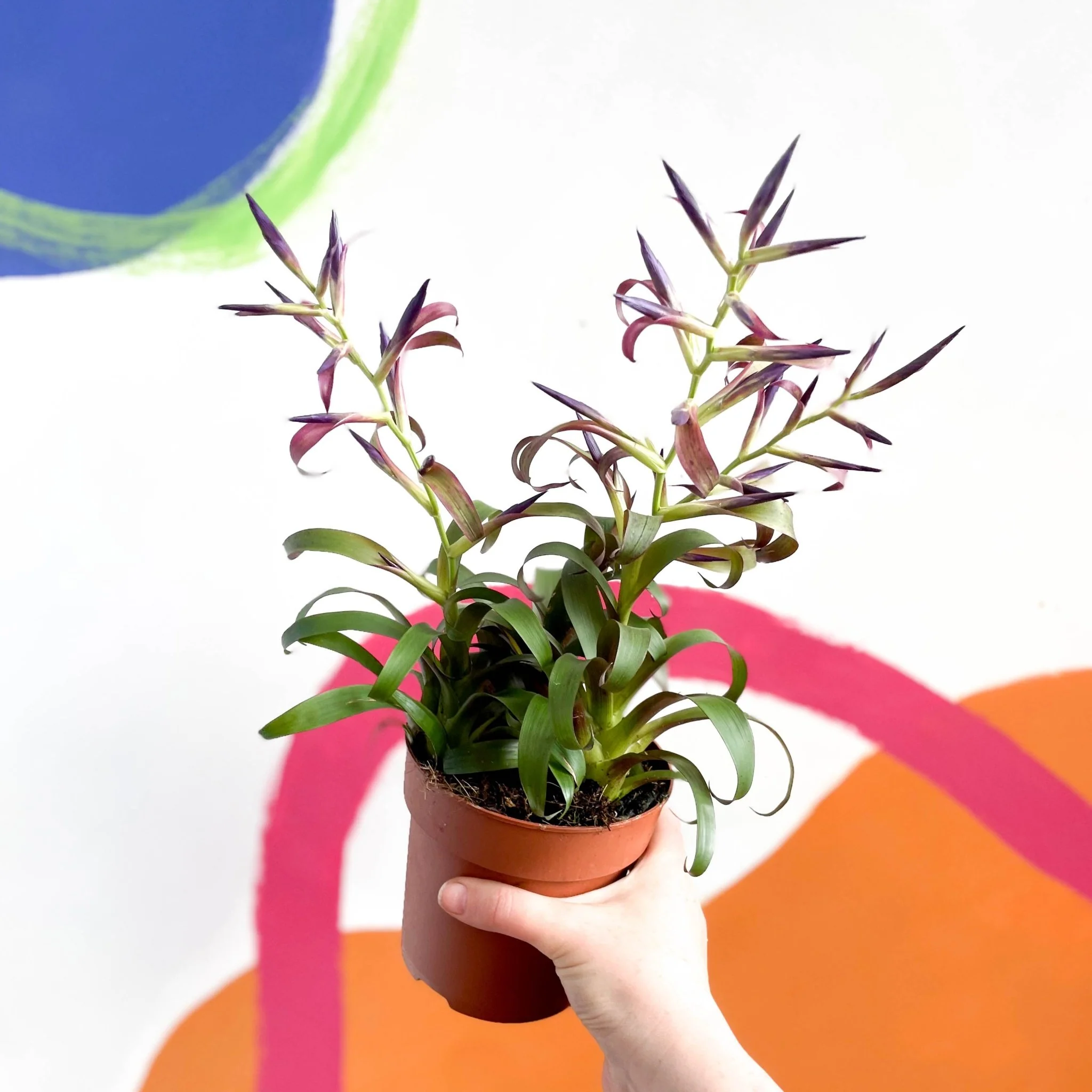
Tillandsia leiboldiana 'Mora'
Scientific Name
Tillandsia leiboldiana (Tillandz' plant, Leibold's variety) 'Mora'
Common Name
Leibold's Tillandsia, Air Plant
Origin
Mexico and Central America
Description
This variety of Tillandsia can grow and thrive in a pot, unlike its more airy cousins. Just make sure it doesn't sit with soggy roots as it is still an epiphyte used to having a bit of air circulation around its feet! Like the other air plants, it grows in layers of green spikes, and these ones will curl back for a truly unusual foliage fountain. This variety will also sprout purple flowers from the middle of this fountain; keep it in a bright spot to encourage flowering, but make sure it doesn't dry out to keep those blooms as long as possible.
Light
Likes bright, indirect light; think of the dappled light you'd get in the branches of a tree.
Water
Misting a couple of times a week will supply sufficient water, as like its air plant cousins this plant can absorb its water in this way. In a drier spot it might need more. As with air plants, make sure the foliage doesn't sit soggy- the soil can be moist, too, but never soggy.
Humidity
This plant likes high humidity; think tropical rainforests, and if it's in a drier spot be sure to mist regularly or add a humidity tray.
Soil
Make sure it's a well-draining or chunky mix for this epiphyte; a mix with added sand or bark would work well.
Food
This slow-growing plant doesn't need much fertilising; if you replenish the soil every year this should provide enough nutrients. If you want to add extra, feed it at the beginning of the growing season.
Temperature
Average household temperatures of about 15-30°C are perfect- make sure it doesn't drop below 15°C in winter.
Pet-safe
Yes, but too much nibbling won't be good for pets, small humans or the plant!
Sprouts Top Tips
Try to use rainwater or distilled water when misting if possible; tapwater, especially hard water, can leave traces of the chemicals in it on your plant (like the limescale on taps or in kettles)
Original: $11.27
-65%$11.27
$3.94Product Information
Product Information
Shipping & Returns
Shipping & Returns
Description
Scientific Name
Tillandsia leiboldiana (Tillandz' plant, Leibold's variety) 'Mora'
Common Name
Leibold's Tillandsia, Air Plant
Origin
Mexico and Central America
Description
This variety of Tillandsia can grow and thrive in a pot, unlike its more airy cousins. Just make sure it doesn't sit with soggy roots as it is still an epiphyte used to having a bit of air circulation around its feet! Like the other air plants, it grows in layers of green spikes, and these ones will curl back for a truly unusual foliage fountain. This variety will also sprout purple flowers from the middle of this fountain; keep it in a bright spot to encourage flowering, but make sure it doesn't dry out to keep those blooms as long as possible.
Light
Likes bright, indirect light; think of the dappled light you'd get in the branches of a tree.
Water
Misting a couple of times a week will supply sufficient water, as like its air plant cousins this plant can absorb its water in this way. In a drier spot it might need more. As with air plants, make sure the foliage doesn't sit soggy- the soil can be moist, too, but never soggy.
Humidity
This plant likes high humidity; think tropical rainforests, and if it's in a drier spot be sure to mist regularly or add a humidity tray.
Soil
Make sure it's a well-draining or chunky mix for this epiphyte; a mix with added sand or bark would work well.
Food
This slow-growing plant doesn't need much fertilising; if you replenish the soil every year this should provide enough nutrients. If you want to add extra, feed it at the beginning of the growing season.
Temperature
Average household temperatures of about 15-30°C are perfect- make sure it doesn't drop below 15°C in winter.
Pet-safe
Yes, but too much nibbling won't be good for pets, small humans or the plant!
Sprouts Top Tips
Try to use rainwater or distilled water when misting if possible; tapwater, especially hard water, can leave traces of the chemicals in it on your plant (like the limescale on taps or in kettles)