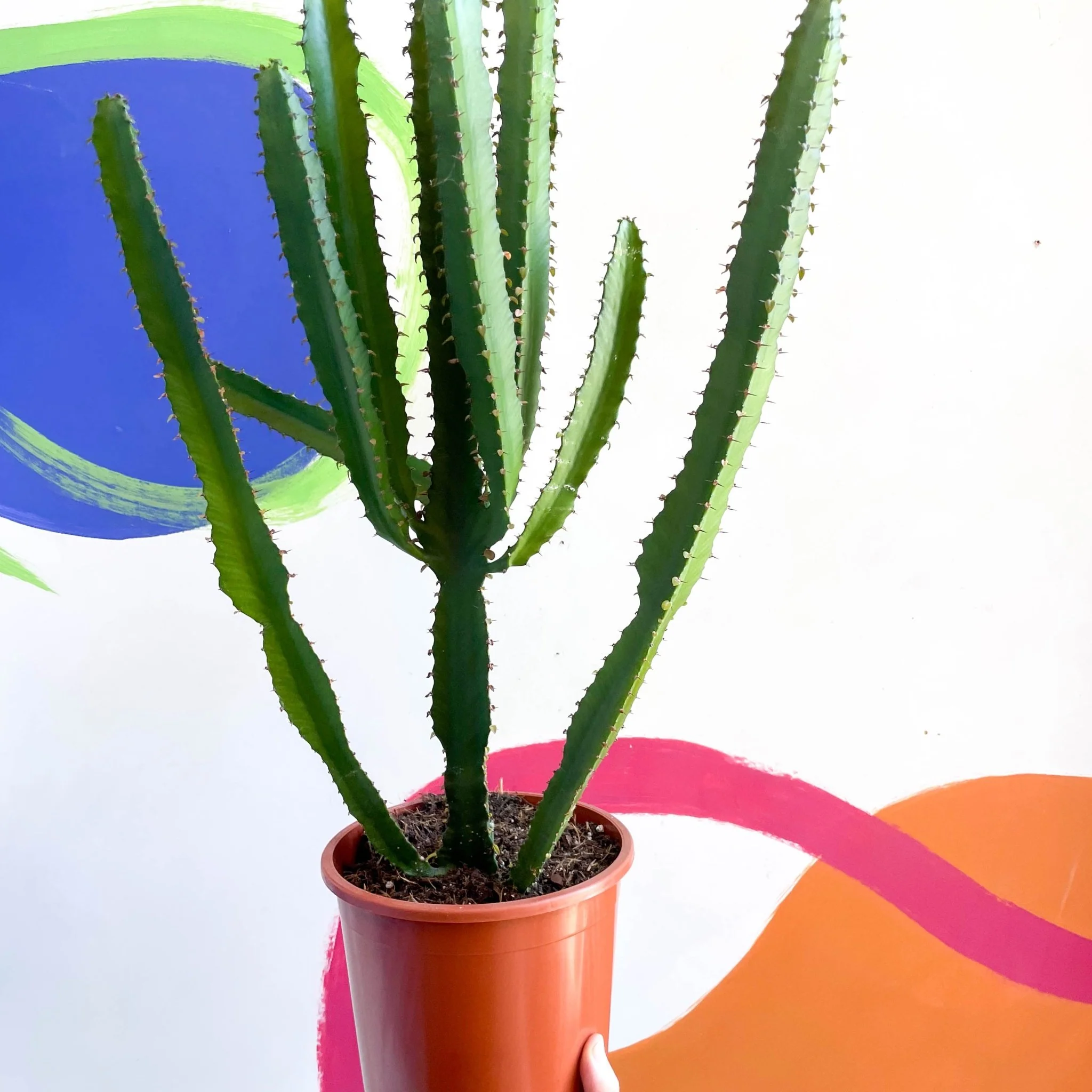
Euphorbia triangularis - Cathedral Cactus
A bold and architectural plant, Euphorbia trigona is often called the Cathedral Cactus thanks to its tall, upright growth and branching, column-like stems. Despite its cactus-like appearance, it’s actually a succulent Euphorbia, with ridged green stems lined with small leaves and sharp spines. Fast-growing and easy to care for, it makes a striking statement in any bright indoor space.
Scientific Name
Euphorbia trigona (‘three-angled Euphorbia’)
Synonyms
Often incorrectly referred to as a cactus due to its appearance
Common Name
Cathedral Cactus, African Milk Tree
Origin
Native to Central Africa, where it grows in warm, dry environments.
Light
Prefers bright light and can tolerate direct sun. A sunny windowsill is ideal. Lower light may result in weaker, stretched growth.
Water
Allow the soil to dry out fully between waterings. Water sparingly, especially in winter. Overwatering can quickly lead to root rot.
Humidity
Tolerates average household humidity and does not require high humidity levels.
Soil
Use a well-draining cactus or succulent mix with added grit or sand to improve drainage.
Food
Feed every 3–4 waters during the growing season with a balanced fertiliser. Reduce feeding in autumn and winter.
Temperature
Prefers temperatures between 18–30°C. Avoid temperatures below 10–12°C and protect from cold drafts.
Pet-safe
Toxic if ingested, and the milky sap can irritate skin and eyes – handle with care and keep out of reach of pets and children.
Sprouts Top Tips
Always handle with care when pruning or moving – the sap can be irritating, so it’s best to wear gloves and avoid contact with skin.
Extras
This plant can grow quite tall over time and may need support or pruning to maintain its shape indoors.
Did You Know?
Unlike true cacti, Euphorbias produce a milky latex sap when cut, which acts as a defence mechanism in the wild.
Product Information
Product Information
Shipping & Returns
Shipping & Returns
Description
A bold and architectural plant, Euphorbia trigona is often called the Cathedral Cactus thanks to its tall, upright growth and branching, column-like stems. Despite its cactus-like appearance, it’s actually a succulent Euphorbia, with ridged green stems lined with small leaves and sharp spines. Fast-growing and easy to care for, it makes a striking statement in any bright indoor space.
Scientific Name
Euphorbia trigona (‘three-angled Euphorbia’)
Synonyms
Often incorrectly referred to as a cactus due to its appearance
Common Name
Cathedral Cactus, African Milk Tree
Origin
Native to Central Africa, where it grows in warm, dry environments.
Light
Prefers bright light and can tolerate direct sun. A sunny windowsill is ideal. Lower light may result in weaker, stretched growth.
Water
Allow the soil to dry out fully between waterings. Water sparingly, especially in winter. Overwatering can quickly lead to root rot.
Humidity
Tolerates average household humidity and does not require high humidity levels.
Soil
Use a well-draining cactus or succulent mix with added grit or sand to improve drainage.
Food
Feed every 3–4 waters during the growing season with a balanced fertiliser. Reduce feeding in autumn and winter.
Temperature
Prefers temperatures between 18–30°C. Avoid temperatures below 10–12°C and protect from cold drafts.
Pet-safe
Toxic if ingested, and the milky sap can irritate skin and eyes – handle with care and keep out of reach of pets and children.
Sprouts Top Tips
Always handle with care when pruning or moving – the sap can be irritating, so it’s best to wear gloves and avoid contact with skin.
Extras
This plant can grow quite tall over time and may need support or pruning to maintain its shape indoors.
Did You Know?
Unlike true cacti, Euphorbias produce a milky latex sap when cut, which acts as a defence mechanism in the wild.