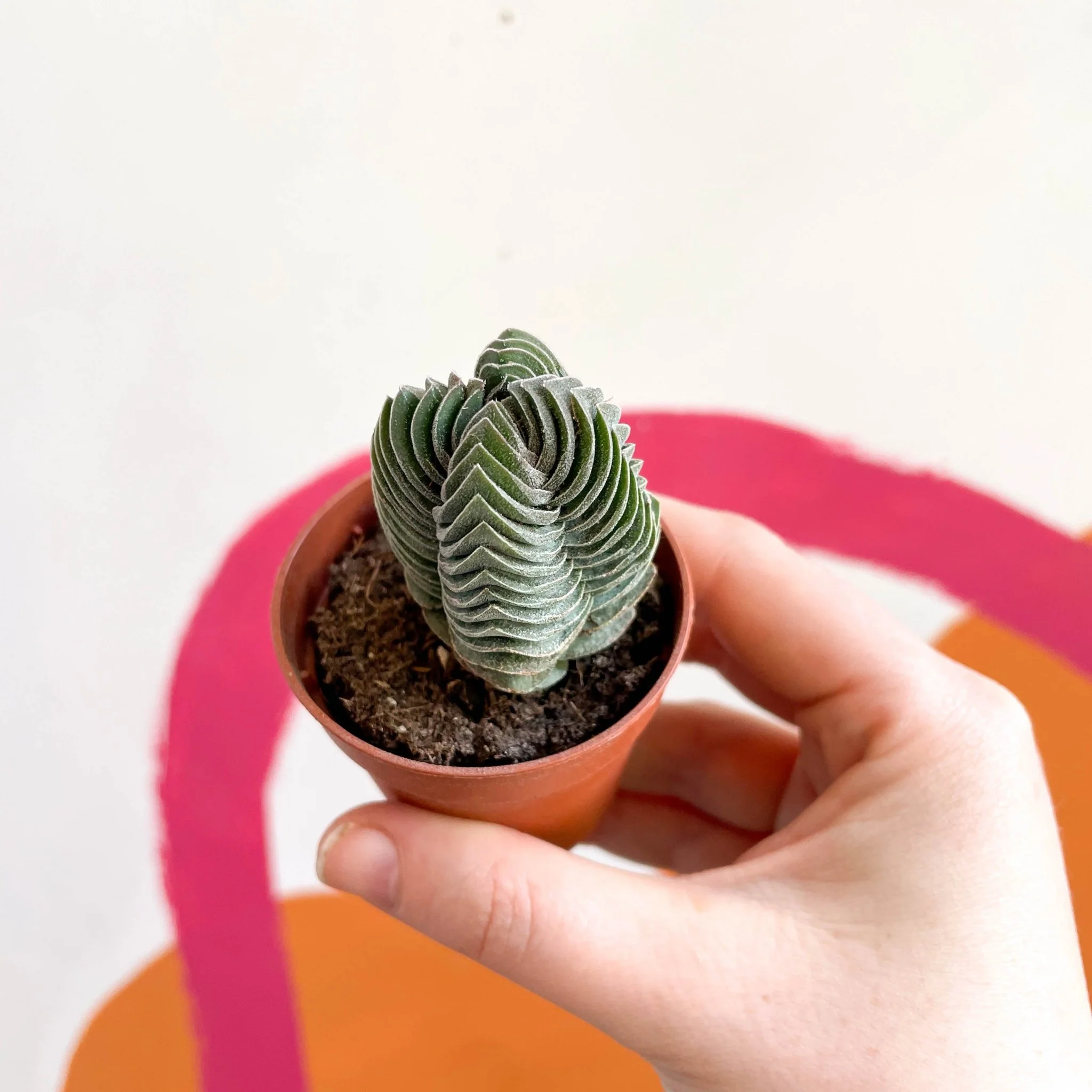
Crassula pyramidalis ‘Compacta’ – Buddha’s Temple
A truly eye-catching succulent, Crassula pyramidalis ‘Compacta’ is admired for its perfectly stacked, square leaves that form a sculptural, temple-like column. Each leaf grows tightly layered atop the next, creating a geometric form that looks almost architectural. Slow-growing and naturally compact, this plant makes a striking feature for sunny shelves and minimalist interiors.
Scientific Name
Crassula pyramidalis ‘Compacta’ (pyramid-shaped thick-leaved plant)
Part of the Crassula genus within the Crassulaceae family. The cultivar ‘Compacta’ has been selected for its tighter, more symmetrical growth compared to the standard species.
Synonyms
Sometimes sold as Crassula ‘Buddha’s Temple’
Common Name
Buddha’s Temple
Origin
Derived from Crassula species native to South Africa, where they grow in arid, rocky habitats.
Light
Prefers bright light, including some direct sun. Insufficient light can cause the stacked form to loosen or stretch.
Water
Allow the compost to dry out completely between waterings. Water sparingly and reduce significantly in winter. Overwatering can quickly cause rot due to the tightly packed leaves.
Humidity
Thrives in low humidity. Avoid misting or placing in damp rooms.
Soil
Use a very free-draining compost, ideally a cactus or succulent mix with added grit. Repot infrequently, as it prefers to be slightly pot-bound.
Food
Feed every 4–5 waters during the growing season with a cactus or succulent fertiliser. Do not feed in winter.
Temperature
Ideal temperature range is 15–26°C. Protect from frost and avoid temperatures below 5–7°C.
Pet-safe
Toxic if ingested. Keep out of reach of pets and children.
Sprouts Top Tips
Water directly into the soil and avoid wetting the leaves – moisture trapped between them can lead to rot.
Extras
Growth is very slow, but offsets may form at the base in ideal conditions.
Did You Know?
The precise, stacked leaf arrangement is an example of mathematical phyllotaxis, where leaves grow in repeating geometric patterns.
Product Information
Product Information
Shipping & Returns
Shipping & Returns
Description
A truly eye-catching succulent, Crassula pyramidalis ‘Compacta’ is admired for its perfectly stacked, square leaves that form a sculptural, temple-like column. Each leaf grows tightly layered atop the next, creating a geometric form that looks almost architectural. Slow-growing and naturally compact, this plant makes a striking feature for sunny shelves and minimalist interiors.
Scientific Name
Crassula pyramidalis ‘Compacta’ (pyramid-shaped thick-leaved plant)
Part of the Crassula genus within the Crassulaceae family. The cultivar ‘Compacta’ has been selected for its tighter, more symmetrical growth compared to the standard species.
Synonyms
Sometimes sold as Crassula ‘Buddha’s Temple’
Common Name
Buddha’s Temple
Origin
Derived from Crassula species native to South Africa, where they grow in arid, rocky habitats.
Light
Prefers bright light, including some direct sun. Insufficient light can cause the stacked form to loosen or stretch.
Water
Allow the compost to dry out completely between waterings. Water sparingly and reduce significantly in winter. Overwatering can quickly cause rot due to the tightly packed leaves.
Humidity
Thrives in low humidity. Avoid misting or placing in damp rooms.
Soil
Use a very free-draining compost, ideally a cactus or succulent mix with added grit. Repot infrequently, as it prefers to be slightly pot-bound.
Food
Feed every 4–5 waters during the growing season with a cactus or succulent fertiliser. Do not feed in winter.
Temperature
Ideal temperature range is 15–26°C. Protect from frost and avoid temperatures below 5–7°C.
Pet-safe
Toxic if ingested. Keep out of reach of pets and children.
Sprouts Top Tips
Water directly into the soil and avoid wetting the leaves – moisture trapped between them can lead to rot.
Extras
Growth is very slow, but offsets may form at the base in ideal conditions.
Did You Know?
The precise, stacked leaf arrangement is an example of mathematical phyllotaxis, where leaves grow in repeating geometric patterns.